
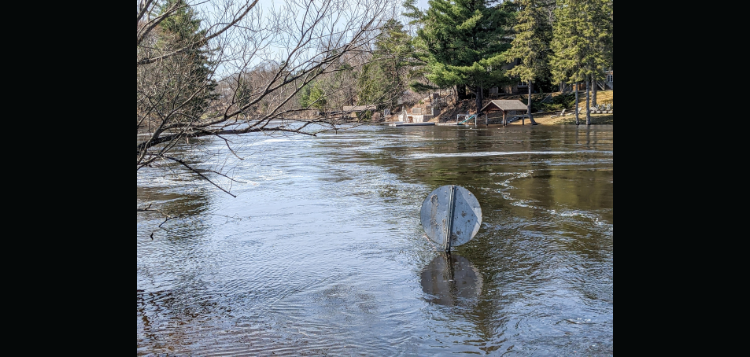
The District Municipality of Muskoka is calling on the provincial government to take urgent action on flooding and watershed management following what council members described as another devastating spring flooding event across the region.
During its May 19, 2026, meeting, District Council unanimously supported a resolution urging the Province of Ontario to move quickly on flood mitigation, disaster recovery assistance and long-term watershed planning in the wake of severe flooding caused by this year’s spring freshet.
The resolution cites widespread impacts to residents, businesses, municipal infrastructure and the natural environment throughout the Muskoka River watershed.
Council heard that the 2026 flooding caused extensive damage to roads, municipal infrastructure and private properties, while leaving many residents displaced, facing mounting financial hardship, and continuing uncertainty as elevated water levels persisted across the region.
Several councillors spoke about the far-reaching consequences of the flooding, including environmental damage, public safety concerns, economic losses and the impacts on tourism-related businesses such as marinas that were unable to open for the season. Others pointed to homes and cottages surrounded by water and significant damage to both municipal and residential properties.
District Councillor Terry Glover said insurance costs are becoming another major burden for residents already struggling with flood recovery.
“Insurance companies are raising rates, and it’s costing residents millions of dollars,” said Glover.
The motion, moved by District Councillor Peter Kelley and seconded by Councillor Rick Maloney, highlights ongoing concerns surrounding recurring flooding within the Muskoka River watershed and calls for stronger provincial leadership on both flood mitigation and disaster recovery.
District Chair Jeff Lehman stressed the increasing frequency of major flooding events in the region.
“This is the third 100-year flood in 15 years, and we’re likely to have another one, and it won’t be long,” Lehman told council.
The resolution notes that municipalities throughout the watershed have repeatedly warned about rising flood risks tied to changing climate conditions and have called for more coordinated, transparent and proactive flood mitigation planning.
Council also referenced the Province’s 2021 investment of more than $4 million into studies and projects examining flood conditions within the Muskoka River watershed and exploring options to reduce future impacts.
While many of the technical studies and the Flood Modifications Review Project have now largely been completed, the resolution states there is growing frustration among municipalities and residents that few tangible flood mitigation measures have followed.
The motion further references a provincial commitment made in November 2024 to review and amend the Muskoka River Watershed Management Plan.
Among the requests outlined in the resolution, council is asking the Province to reaffirm and accelerate that commitment, establish a formal implementation framework complete with timelines and public reporting, and hold public information sessions in affected watershed communities by mid-June 2026.
Council is also urging the Province to activate both the Disaster Recovery Assistance for Ontarians program and the Municipal Disaster Recovery Assistance program while expediting financial support for impacted communities.
In addition, the resolution asks the Province to expand disaster recovery eligibility to include seasonal and secondary residential properties, noting their importance to Muskoka’s economy and municipal tax base.
Glover said council must continue pressing the Province for action.
“We need to hold them to everything they promised and more,” he said. “There is more that could be done. We need to underline issues that didn’t get addressed and do everything that can be done.”
Maloney echoed concerns about the increasing regularity of extreme flooding events.
“We’re getting to a point now where 100-year floods are commonplace,” he said. “There’s only so much that folks can take.”
District Councillor Heidi Lorenz also questioned what steps municipalities themselves are taking to prevent future losses.
“What are we doing to ensure people aren’t rebuilding in areas they shouldn’t… investing in areas they shouldn’t be investing in… to protect them because it’s heartbreaking,” Lorenz said.
She added, “What’s our plan? What are we going to do so this doesn’t happen anymore?”
Staff advised council that work on the District’s Official Plan is ongoing and will include future discussions surrounding floodplain development, land use planning and mitigation strategies.
A copy of the resolution will be forwarded to Ontario Premier Doug Ford, provincial ministers, First Nations communities, MPP Graydon Smith, municipalities throughout the Muskoka River watershed, and the Association of Municipalities of Ontario.
You can find the resolution HERE (PDF).
Don’t miss out on Doppler!Sign up here to receive our email digest with links to our most recent stories.
Local news in your inbox six times per week!
Click here to support local news

Gee, it’s too bad there wasn’t a 60+ year concept of municipal cooperation for the purposes of reducing flood risk and encouraging the sustainable use of watersheds that one could follow eh? (incidentally one that has been lauded internationally) Y’know, one that involves input and cooperation between all levels of government and users of water such that decisions (and in particular the cumulative impact of) made up-stream and down-stream of each other didn’t impact the health and welfare of all species up and down. Such an organization could provide sound advise to municipalities about how to mitigate damages, how to off-set flood storage losses, monitor water leaves 365 days of the year, hire hydrologists and riparian specialists. So much more, like track the cumulative impact of hardening once permeable spaces, removing flow attenuating vegetative cover etc.
You could call it something like hmm, a Conservation Authority? And then fund it with local levies, private donations, grants, fees for services and dwindling input from Federal and Provincial governments, as has been done with 60+ years in other places. And, you could govern said organization with local people who know the area, the history of flood areas, what’s up-coming in their lower-tier municipalities, appoint specialists like fish biologists to the board and committees as well for learned input…..
But, then you’d run the risk of having said organization being amalgamated with other such entities at the decree of the province (including our current MPP) for no defensible reason. And then you could have a random provincial appointee – with no particular expertise in the very complex matter of water management – to head the amalgamated organization to overrule decisions made on all work undertaken with sometimes less than 20% of dollar input from the province. (check the recent annual reports of existing CA’s for actual audited figures). Yeah, that sounds like the kind of coordination that people are asking for across the Muskoka Lakes Watershed.