
By Hugh Holland
We know that climate change is now having a profound impact on all aspects of life. But what drives climate change?
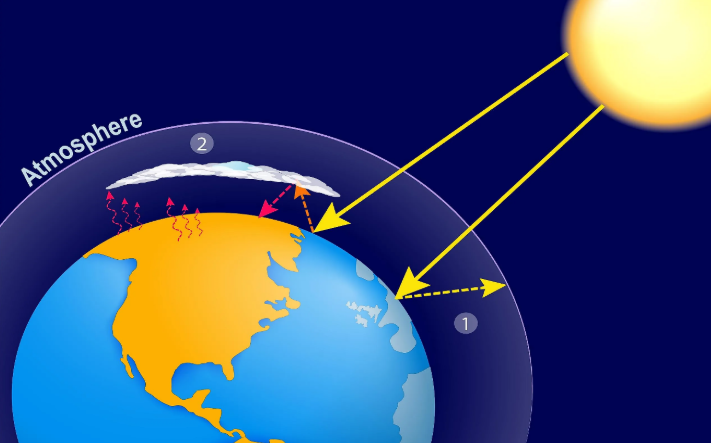
The Earth is surrounded by a 100 km-wide atmosphere composed of 78% nitrogen, 21% oxygen, and trace amounts of argon and carbon dioxide (CO2). The atmosphere blocks the penetration of -245°C cold from outer space. For centuries, the average temperature and weather conditions around the Earth and its atmosphere remained stable at around 13.5°C.
But with the start of the industrial age in 1850 came the burning of fossil fuels, which added more carbon dioxide to the atmosphere. Carbon emissions act like a greenhouse roof, trapping heat from the sun and raising the average temperature of the Earth.
The population in 1850 was 1.2 billion people, and emissions were estimated at 204 million tonnes. 175 years later, in 2025, the population had risen 6.8 times to 8.2 billion, and emissions had risen 186 times to 38 billion tonnes because emissions don’t go away. They keep accumulating in the atmosphere. The Earth’s average temperature has risen by almost 2°C above 13.5°C and is expected to keep rising.
That doesn’t sound like much, but climate scientists estimate it’s equivalent to adding billions of Hiroshima bombs’ worth of heat to raise the temperature that much while continuing to offset the penetration of extreme cold from outer space.
Like turning up the heat on a pot of water, currents change, bubbles form in new places, and the whole system becomes turbulent. The more emissions, the more heat is trapped, the more unbalanced the system becomes, and the more unstable the climate becomes.
For 150 years, countries and companies used religion and politics in their competition for control of fossil fuels. But now, we really have only one common enemy: climate change.
Much of what is happening to American democracy has its origins in the strategy of the multi-billionaire Koch brothers, fossil fuel owners who started “Citizens United” and lobbied for two decades to change election campaign laws so that corporations and trade unions can contribute directly to election campaigns and buy their politicians. That was approved in 2010.
Climate change is accelerating, and there is no longer a genuine scientific dispute about the reality of global warming and its causes. And there is now a clear path for a transition to an “electrotech” economy.
The electrotech revolution is the most profound transformation of the world’s energy system since the shift from biomass to fossil fuels in the 18th century. As electrotech costs fall and exponential growth continues, a century of evolution is converging into a decade.
Three groups of technologies are coming together to form electrotech – a revolution in the way the world generates, stores, and moves electricity – renewable supply from solar and wind; falling energy demand from electric vehicles (EVs) and heat pumps.
1. Physics: Electrotech makes the energy system more efficient
Electrotech is about three times more efficient than fossil-fuel systems, which waste two-thirds of primary energy as heat at a cost of $5 trillion every year. Solar and electrification enable us to harness the power of the sun, which gives access to 100 times as much energy as fossil fuels.
2. Economics: Electrotech gets cheaper as it scales
Fossil fuel commodities get more expensive as extraction continues, and their prices are elevated by major producers controlling the supply. Electrotech is manufactured and modular, resulting in clear learning curves, with costs falling by around 20% every time deployment doubles. Electrotech is already capturing two-thirds of global energy investment and is responsible for all the expected growth in energy jobs. Electrotech contributed 10% of global GDP growth in 2023, including 22% in China, 5% in India, 30% in the EU, 7% in the US.
3. Geopolitics: Electrotech enhances independence and security
Eighty per cent of the world lives in fossil-fuel-importing countries, with over 50 countries importing more than half of their primary energy as fossil fuels. In contrast, 92% of countries have renewable energy potential more than 10 times their current demand. Replacing imported fossil fuels using three key levers—EVs, heat pumps and renewables—can cut net fossil fuel imports by 70%, saving $1.3 trillion globally each year. Once electrotech is bought, it lasts for decades, providing insulation from the vagaries of global pricing.
We now have a choice to make. Either we, including the fossil fuel companies, embrace a rapid transition to electrotech with an infinite supply of clean energy and an improving environment. Or we continue with finite fossil fuels until we run out, and face energy shortages along with a rapidly deteriorating environment from climate change.

Hugh Holland is a retired engineering and manufacturing executive now living in Huntsville, Ontario.
Don’t miss out on Doppler!Sign up here to receive our email digest with links to our most recent stories.
Local news in your inbox six times per week!
Click here to support local news

Oil is becoming less and less relevant in the world.
This is great for reducing the cost of living, great for the planet and great for world peace. A future we can be optimistic about.
The rate of increase in consumption is reducing then will level off then start dropping.
“Global oil demand growth slowed from 1.9% in 2023 to a more moderate 0.8% in 2024, falling below the pre-pandemic average growth rate of over 1%.”
Peak oil is likely 2030.
Although the TMX oil pipeline and Kitimat LNG mean Canada can finally sell our resources to Asia, instead of only the US at a discount, it’s very unlikely there will be another hugely expensive pipeline like TMX.
LNG projects will continue for a few years.
China has already passed peak oil as they are 60%+ ev for new cars. Refineries for gas are closing.
The recent high cost of oil just accelerates the above.
China’s emissions are flat and going down for the last two years. In spite of a huge increase in power demand.
All new demand is met, and then some, with renewables and storage. 93% of new power in the world, including in the US, is renewables and storage. Least expensive and most reliable source of power in the world now. Not just to save the planet.
Energy independence is another reason to go green. No more relying on other countries for energy. No more wars over oil.
Global warming is real, Science is real, end of story.
I don’t believe the climate change narrative. I’m not a climatologist, but I have read the opinions of many well respected scientists that dispute the official rhetoric, and their arguments are convincing. And, as is often the case, both sides can quote an overwhelming amount of data to support their opinions. Most of us can’t argue with the numbers because we’re not qualified to do so, so in forming our opinions we have to ask who do we trust to tell us the truth?
The people we should trust are those that we elect to represent our best interests. Unfortunately, we can’t do that. As the commentary points out, corporations and trade unions can contribute directly to election campaigns and buy their politicians. The same applies to billionaires and foreign interests that influence our elections for personal gain. It shouldn’t be allowed, but it is. The net result of this is that we cannot trust what our government tells us, because they don’t work for us.
The pandemic is a good example of this when the public was controlled and manipulated through constant government misinformation and fearmongering, reinforced by the mainstream media. There was no debate allowed, despite there being thousands of qualified people who disputed what the government was saying. The pandemic resulted in the biggest transfer of wealth in history, and regular people suffered tremendously. Throughout this time, the Liberal government fed us lie after lie after lie. The truth about all of this deception is now coming out.
Now the government is preaching the dangers of climate change and people are jumping on the bandwagon again. Yet we can see with our own eyes that geoengineering and weather modification is happening constantly. We just need to look up. Our weather is being manipulated and this manipulation is endorsed by our government. We should think about that. If this weather manipulation were a good thing, the government would be taking credit for it, but they won’t talk about it. Who is spraying? Why are they spraying? What chemicals are being sprayed? What is the effect on our environment? We should be demanding answers from this government. The government is not telling us what’s going on, but they will point at all weather anomalies and blame climate change, while many of these anomalies are being manufactured.
After the last 10 years the Liberal government has no credibility. The trust is gone. But, rather than working to restore that trust, they are passing legislation to censor news and opinion. They are trying to control the message. They don’t want us talking to each other, they just want to put their propaganda on repeat under the guise of controlling misinformation. And many people fall for it. This does nothing to enhance trust. If anything, it should make us more suspicious of their motives.
They are pushing the climate change message continuously, but given their track record, I believe it’s more lies and more manipulation. I have no reason to think otherwise and their actions to control the narrative do nothing to restore the trust. So, as I said, I’m not a climatologist, but I can look at the government track record and common sense tells me that whatever the government is telling us about climate change cannot be believed.
We would have cleaner air if global trade and global travel was limited like it was in the pandemic! That is not likely to happen when people like our prime minister is jetting to places like China and India (two of the worst polluters in the world) to make trade deals. Don’t be fooled by people that use per capita figures to say that they are not two of the worst! You can build all the solar panels and electric cars you want, it won’t change anything until our global trade and travel habits change!