
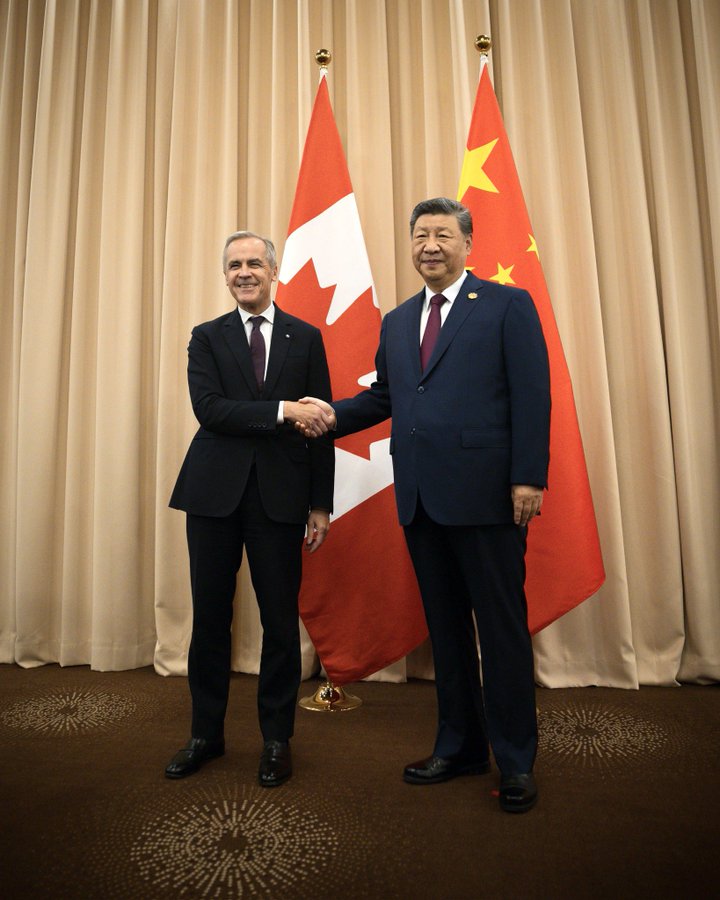
“We take the world as it is and not as we wish it to be.” – Prime Minister Mark Carney.
It was another chaotic week in world politics, something notable happening on almost every front. Chief among these for Canadians was Prime Minister Mark Carney’s visit to China.
Although prior to going, Mark Carney damped down expectations related to the trip, he came away with a bushel full of agreements, a feat that many Canadians will applaud, while others will have grave concerns. In total, eight agreements were signed in areas of finance, public safety and energy.
As well, at the Summit Meeting and in related talks in China, Canada has agreed to remove its 100% tariff on Chinese electric vehicles, reducing the tariff to 15% and allowing almost 50,000 Chinese EV’s into Canada at the most favoured-nation rate of 6.1%, increasing to 6.5% in subsequent years.
At their end, China is dropping its tariff rate on Canadian canola seed from 85% to 15% as well as on other agricultural products and seafood, effective March 1.
In his meeting with Chinese President Xi Jinping, Mark Carney noted that “the world has changed much in the last ten years and the strategic partnerships my government is seeking with Beijing sets us up well for the new world order.” He said the discussions and agreements with China ushered in “a new era of relationships.”
President Xi has responded by saying that Canada -China relationships are on an upward trajectory and that he is heartened by the results of the meeting with Mark Carney.
Prime Minister Mark Carney will not return to Canada with empty hands after world travels at taxpayer’s expense, as some opposition critics have predicted. But he will return to a debate as to whether Canada should commit to a “strategic relationship” with China, given their record on human rights, election interference in Canada and the imprisonment of two Canadians as a bargaining tool against a high-ranked Chinese National in Canada who was under indictment.
Concerns about Canada’s new trading alliance with China are legitimate. Previously, the relationship between these two countries has been cool, to put it mildly. Seeking closer ties with a country that does not value democracy, human rights or territorial boundaries and whose record related to Climate Change is less than stellar is a significant risk.
Prime Minister Mark Carney has been clear that Canada’s trade agreement with China “reflects the world as it is today,” and that the two countries will collaborate on issues they agree upon and stay in their own lanes on issues where they do not.
The reality of the world “as it is today”, is that all three superpowers, Russia, China and now the United States, have despotic tendencies. In a recent Globe and Mail article, journalist Andrew Coyne put his finger on the challenge Canada is facing today.
Coyne points out that, “there will probably always be human rights issues in China and Russia.” Then he goes on to say, “We (Canada) cannot pretend to have warm relations with a country (China) that kidnaps our citizens, messes with our elections and intimidates members of the diaspora – to say nothing of its bestial treatment of its own people, or its aggressive designs on its neighbours.”
“But then”, Coyne continues, “Donald Trump returned to the White House and, having returned, began issuing a series of threats not only to our trading relationship but to our very sovereignty. And so, we have to recalibrate once more. Not because China has become any less dangerous, but because the U. S. has become more so.”
The difference, and the need for recalibration, is that China wants to trade with Canada and the United States does not. Given the current circumstances, Canada must have reliable trading partners.
President Trump has said time and time again that the United States does not need to buy anything from Canada. That may be just a negotiating tactic but until reality checks in, Canada must take threats from the United States at face value and act accordingly.
It is interesting to note that, as of this writing, American President Donald Trump approves of the deals that Canada has made with China. A reporter asked him, “What do you think about Carney signing a Trade Deal with China?” Trump’s response: “That’s okay – That is what he should be doing. It’s a good thing to sign a Trade Deal with China.”
The problem is that is what Donald Trump said yesterday. Who knows what he will say about it tomorrow?
The reality is that Canada can no longer rely on what the President of the United States says or does. There is no certainty that he will renegotiate the U.S., Canada and Mexico Free Trade Agreement, which is up for review this year. If he does, it will be heavily weighted toward the United States.
As well, in addition to the already crippling tariffs from the United States, Canada risks another across the board 10% tariff for vowing to support Greenland against any attack or takeover by the United States.
In recent days, Mark Carney has said, “Our full partnership and obligations to Article 5 (in NATO) stands. We stand fully behind them. Canada will back Denmark and Greenland.” Although there has been no reaction from Trump yet there likely will be. He has already imposed an additional 10% tariff on eight European countries that have come out against the annexation of Greenland by the United States.
Canada must remember that U.S. President Donald Trump believes he can do pretty much whatever he wants in the Western Hemisphere. He is no longer a reliable trading partner, and he remains a real threat to Canada’s sovereignty.
It is the United States that is forcing Canada to seek new allies and trading partners. It is also about time.
Under all of these circumstances, Canada is doing the right thing in stabilizing our relationship with China. Is it risky? Yes, but it is also necessary.
Mark Carney has taken a bold step forward in an effort to improve and stabilize Canada’s economy. Hopefully, with a better relationship, he can temper China’s illegal actions in Canada.
No doubt on the home front, the Prime Minister will face a damned if you do and damned if you don’t scenario from many Canadians.
On balance, however, I believe that Mark Carney did the right thing in negotiating a new and better alliance and trading agreement with at least one of the world’s three super-powers.
As the Globe and Mail headline on Andrew Coyne’s article about the trade deal between Canada and China reads, “Canada is hedging its bets.”
In my view, Canada has no choice. We need to take the world as it is.

Hugh Mackenzie has held elected office as a trustee on the Muskoka Board of Education, a Huntsville councillor, a District councillor, and mayor of Huntsville. He has also served as chairman of the District of Muskoka and as chief of staff to former premier of Ontario, Frank Miller.
Hugh has also served on a number of provincial, federal and local boards, including chair of the Ontario Health Disciplines Board, vice-chair of the Ontario Family Health Network, vice-chair of the Ontario Election Finance Commission, and board member of Roy Thomson Hall, the National Theatre School of Canada, and the Anglican Church of Canada. Locally, he has served as president of the Huntsville Rotary Club, chair of Huntsville District Memorial Hospital, chair of the Huntsville Hospital Foundation, president of Huntsville Festival of the Arts, and board member of Community Living Huntsville.
In business, Hugh Mackenzie has a background in radio and newspaper publishing. He was also a founding partner and CEO of Enterprise Canada, a national public affairs and strategic communications firm established in 1986.
Currently, Hugh is president of C3 Digital Media Inc., the parent company of Doppler Online, and he enjoys writing commentary for Huntsville Doppler.
Don’t miss out on Doppler!Sign up here to receive our email digest with links to our most recent stories.
Local news in your inbox six times per week!
Click here to support local news

There are many human rights issues in our largest trading partner, the US, ever since Trump.
Canada desperately needs to sell our products including canola to China.
Canadians desperately need to save money buying and operating their cars.
Canadian autoworkers desperately need employment as legacy automakers move production south at Trump’s behest.
The world desperately needs to reduce CO2 emissions and the smog related health care costs.
All of the above can be rapidly accomplished by eliminating or greatly reducing the tariff on Chinese EVs.
Follow EU countries not the US who are attempting to decimate the auto industry in Canada.
Encourage the Chinese to build in Canada to avoid any tariff just like the Japanese were encouraged to build in Canada to avoid any tariff.
EU countries are encouraging Chinese companies to build EVs in the EU to avoid the 35% tariff.
Chinese EVs are selling well in EU countries in spite of the 35% tariff.
The US should expect that we go to alternative countries for trade when they put huge tariffs on our products.
The only reason EV sales are down in North America is because inexpensive, high quality EVs from China have a 100% tariff on them.
Which is why China put tariffs on our products including canola so the market for our farmers dried up.
EV sales are up 30% yr/yr in the rest of the world where Chinese EVs have zero or relatively low tariffs.
The only hope for Canada’s auto sector is to encourage the Chinese to build EVs in Canada in plants vacated by high cost legacy automakers as they move south. Possibly within 3 years.
“Doug Ford says only compromise with China is opening an EV factory in Ontario”
It will probably be in non-union plants just like Toyota and Honda in Ontario.