
“Diplomacy is the art of telling people to go to hell in such a way that they ask for directions.”
–Anonymous
I think most readers would agree that is not me. Diplomacy and subtlety are not something I am known for. I am much more likely to shoot from the hip.
Last week I wrote an article about Ontario Premier Doug Ford and in the comment section I pretty well got beaten up. I expected that.
One of my favourite left-of-center friends wrote, “Your regular readers do not agree with you on this one.” Not entirely accurate, as Listen Up has thousands of readers across the political spectrum. But I get the point, and I have no problem with folks disagreeing with me.
It has never been my goal to please everyone, every time. How boring would that be! I like to stir it up on both sides of the aisle once in a while, and our readers appreciate that. I believe it is important to foster different viewpoints, and respectful debate is always a good thing.
So, this week I have decided to go two for two, maybe get beaten up again, but hey!
I am a fan of King Charles III for a number of reasons and am happy that he is Canada’s Sovereign. So, there you go. May I suggest you read the entire commentary before you start pounding the keys? 😊
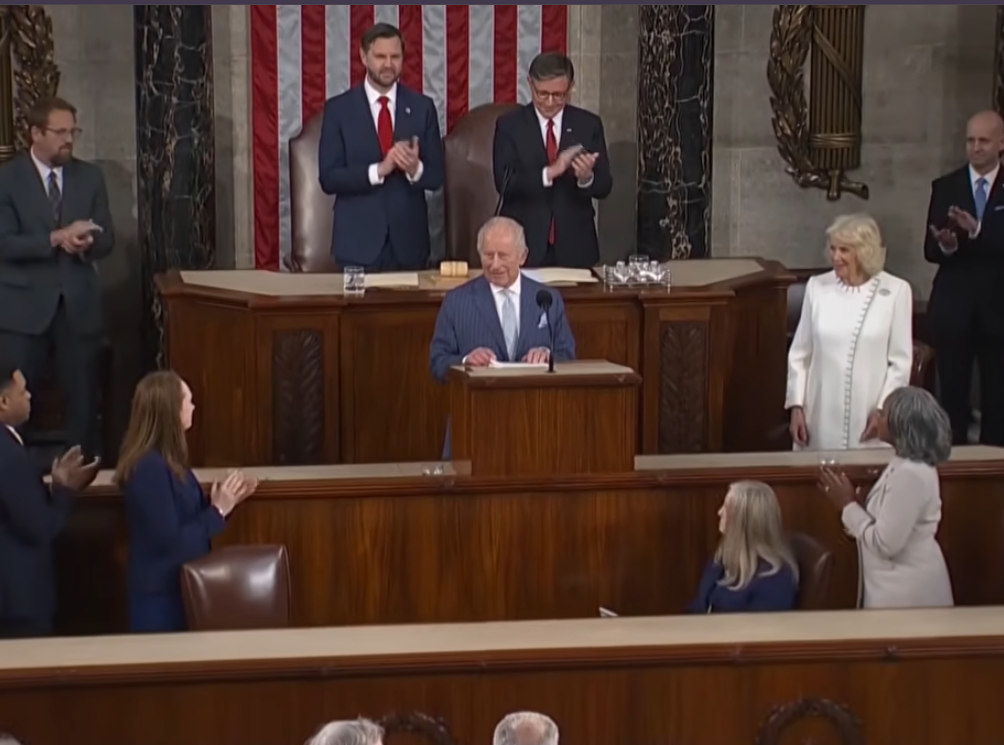
Let’s start with the state visit this past week by King Charles to the United States. It was a masterpiece in diplomacy and subtlety and an important moment on the world stage. President Trump may not have understood all of it, but those around him certainly did.
I cannot think of anyone else who could march into the United States Congress during current times and remind Americans that a key component of what they had inherited from Great Britain was a legal principle that executive power was subject to checks and balances. In her recent Toronto Star article, journalist Rosie DiManno noted that this was a principle that Donald Trump “has fundamentally unheeded in his second occupation of the White House.”
Nevertheless, the King’s statement resulted in a standing ovation, lasting several minutes, from both sides of the aisle, something Donald Trump admitted he had never been able to achieve.
DiManno also wrote in her article, “Notably, Charles revisited his own naval career — Trump, of course, has never served in the military, ducked the draft five times — while praising NATO and doubling down on crucial support for embattled Ukraine with the Trump administration largely halting further military aid. “
Two of my favourite messages delivered to President Trump with a humorous and friendly tone, but nevertheless, saying what he thought it important to say, were first, “You recently commented, Mr. President, that if it were not for the United States, European countries would be speaking German. Dare I say, if it wasn’t for us, you’d be speaking French.”
And second, perhaps the best zinger from our point of view, was King Charles finding a way to remind Donald Trump who the King of Canada is. Diplomatic language for ‘Don’t mess with me.’
I am well aware that the matter of Canada remaining a monarchy with our Head of State also being the King of Great Britain is controversial, with a sizeable number of Canadians believing we should become a republic.
However, it is my view that Canada should always remember its English and French roots. We are much more diversified now, but one should never forget from whence we came. Canada’s English and French roots are not historical trivia—they are embedded in our law, governance and identity.
These are the institutions and traditions that shape public life. Canada’s diversification with new people and new ideas will and should influence these institutions and traditions, but it should not ignore or replace them. Diversity without any shared reference point can drift into fragmentation, and we should not want that to happen.
The most important reason, in my view, for Canada to remain a monarchy is that it distinguishes us dramatically from the United States, both in terms of governance and institutional infrastructure. We are different than the United States, and our ability to stay that way and to avoid creeping and intentional osmosis depends on those differences.
There are only three governance models in this world that I am aware of: monarchies, republics and one form or another of dictatorships. The United States is a republic, leaning, at least for now, toward a more despotic form of governance.
Canada’s system of governance separates symbolic authority from political power. The Crown —embodied federally by the Governor General — acts as a constitutional backstop. A constitutional monarchy in Canada dampens the tendency toward personality-driven politics. No Canadian prime minister can claim to be the state itself.
In contrast, the republican model merges the head of state and the head of government in one elected figure. That can concentrate political emotion, control and identity, as we are seeing during the presidency of Donald Trump in the United States.
Canada remaining as a constitutional monarchy reinforces a different political structure than that of the United States: less revolutionary, more evolutionary, less personality-driven, and more institution-driven.
I am aware that there are those who believe that a monarchy whose King or Queen is also the Sovereign of Great Britain is outdated colonialism. While I have some empathy with that, I would prefer to view it as our independent system of governance flowing from the reality and the tradition of the platform on which Canada was created.
As a monarchy. Canada’s system of governance offers a quieter and more secure strength, continuity without rigidity, and identity without exclusion.
I am good with that, and I am good with Charles III as King of Canada.
God save the King.

Hugh Mackenzie has held elected office as a trustee on the Muskoka Board of Education, a Huntsville councillor, a District councillor, and mayor of Huntsville. He has also served as chairman of the District of Muskoka and as chief of staff to the former Premier of Ontario, Frank Miller.
Hugh has also served on a number of provincial, federal and local boards, including chair of the Ontario Health Disciplines Board, vice-chair of the Ontario Family Health Network, vice-chair of the Ontario Election Finance Commission, and board member of Roy Thomson Hall, the National Theatre School of Canada, and the Anglican Church of Canada. Locally, he has served as president of the Huntsville Rotary Club, chair of Huntsville District Memorial Hospital, chair of the Huntsville Hospital Foundation, president of Huntsville Festival of the Arts, and board member of Community Living Huntsville.
In business, Hugh Mackenzie has a background in radio and newspaper publishing. He was also a founding partner and CEO of Enterprise Canada, a national public affairs and strategic communications firm established in 1986.
Currently, Hugh is president of C3 Digital Media Inc., the parent company of Doppler Online, and he enjoys writing commentary for Huntsville Doppler.
Don’t miss out on Doppler!Sign up here to receive our email digest with links to our most recent stories.
Local news in your inbox six times per week!
Click here to support local news

I am one of your regular readers who often disagrees wholeheartedly with some of your opinions. However, I am definitely on your page when it comes to the monarchy. Our system of government has developed over many years and we must not forget the role of the Monarch in that evolution. King Charles’s speech to the US Congress was a wonderful example of “soft power”.
In our system of government, if a Prime Minister goes rogue, he or she can be removed with a vote of no confidence. It’s too bad the US has no such mechanism for removing a President.
Well
Here is one on your side.
Totally agree.
King Charles 111 was brilliant! Your article was brilliant and I agree with your comments. Thank you for making me feel even more proud to be a CANADIAN.🇨🇦
Governance in the Westminster style, with its “no confidence” motion available, means that an allegedly mentally unstable, corrupt felon would never last long, even if s/he somehow achieved the role of Prime Minister. Watching the devolution of the republic that is our neighbour is sad and troubling indeed. I wrote about King Charles’s humourous but effective diplomacy, delivered in my blog last week. Happy to call him my King, and his Mother my Queen.
Mr. Mackenzie, even the worst batter in the line up gets a hit every now and then. It usually happens when that batter gets a “fat” pitch. It can only happen if the batter isn’t afraid to swing the bat. You are not afraid to swing the bat. So keep on swinging!
I think you’re getting a lot more support on this one. Well said and spot on!
There has always been some sort of “hard to pin down” factor to Canada having a monarch one step above our elected government that I sort of liked. I have to admit, I’m from the English side of our history for what that is worth and although I struggled mightily with French in school, I’d be a poor candidate to be a translator.
This said, I was quite proud of the way King Charles managed to put Trump in his place while not actually antagonizing the guy. He even got a better trade deal out of the visit, at least for Scotch Whisky.
I think we are better off in Canada having an association with the old British Empire, embodied by the King.
I tend to agree with Dale Hajas on the topic, although some details of having a monarchy remain hard to pin down, I think they exist and if they make us different from the USA, that is probably a good thing these days.
Years ago, I wrote a column for The Huntsville Forester called The View Askew, in which I argued rather enthusiastically, for ditching the monarchy. Consider this my formal retraction.
If I needed only one reason to think differently now, it’s this: the monarchy draws a clear line between us and the United States; not just symbolically, but structurally. It reinforces a system of governance and institutions that are distinctly our own. And in a world where influence has a way of quietly seeping across borders, those distinctions matter. They help ensure that we remain exactly that – distinct.
God Save the King, indeed.
God Save The King. Amen.
It’s an excellent article Hugh. Another favourite line of King Charles was his reference to Oscar Wilde saying something like, these days Great Britain and America have so much in common, except our language.
I love language and have found a word which can mean it’s exact opposite depending on whether it is active or passive in the sentence and that is the word “eluded”. And as the high chair president looked at Melania for help in understanding the Oscar Wilde comment I realized that it’s meaning had eluded him and knowing that going in King Charles, a grown up with a sense of grace, history and humour had eluded the wrath of the President.