
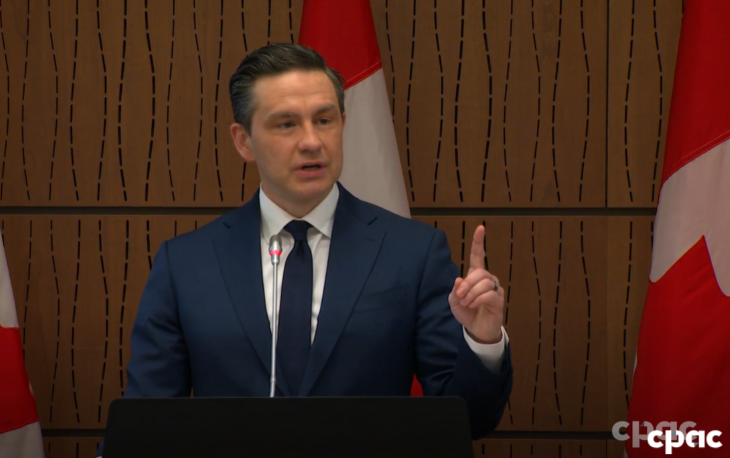
At the end of January, Conservative delegates will meet in Calgary for a national convention. Their major task will be casting a secret ballot to determine whether Conservative Leader Pierre Poilievre should remain in his post or if a leadership race should be called. This is required by the Constitution of the Conservative Party of Canada after an unsuccessful election.
Will Pierre Poilievre survive this leadership vote?
Although a secret ballot sometimes results in a surprise, he likely will. Tracking last month by Abacus Data shows that 77 per cent of Conservatives still support Pierre Poilievre.
Why? Arguably, because he significantly increased the popular vote for Conservatives, as well as winning more seats in the House of Commons for his party, since Brian Mulroney was Prime Minister of Canada.
Still, the Conservatives were not successful in winning the 2025 election, and one needs to take a hard look at that.
A few months before that election, the Conservatives were more than 20 points ahead of the governing Liberals. It was generally thought that a Tory win would be a slam-dunk. That, in part, was because many Liberals, disaffected with Justin Trudeau, parked their support with the Tories to send a clear message to Trudeau. It was time for him to leave.
When Mark Carney came along, many of those Liberals returned to their home base. As well, many traditional Conservative policies were kidnapped by Carney as he moved the Liberal Party of Canada back to the centre of the political spectrum.
Polling related to the 2025 federal election has shown that it was not Conservative policies that many voters rejected. Rather, they simply did not like Pierre Poilievre, and they rejected him. With Trudeau out of the way and Mark Carney becoming the Liberal leader, it was much easier to vote for Carney over Pierre Poilievre.
For those who doubt that, take a look at current polling numbers. Liberals and Conservatives are virtually tied at 41 per cent. But when it comes to which leader is most liked, Mark Carney beats Pierre Poilievre by 39 points. That would be a deciding factor in any election.
It seems pretty clear to me that a significant problem for the Conservative Party is that most Canadians do not like their leader, Pierre Poilievre. He has an aggressive and hostile style that many find offensive and unproductive. They are tired of his slogan-driven approach to policy and are concerned that he leans toward the right of his party.
Whether that is fair or not is another question. I know of several people who have met Pierre Poilievre at private gatherings and were impressed by a much different persona and his grasp of public policy issues.
But that is not the image that Poilievre presents in public, and since the election, he has been adamant that he has no intention of changing it. For this reason, if for no other, in my view, delegates to the Conservative convention in January should carefully consider the ballot question, and that is, whether Pierre Poilievre can ever become Prime Minister.
My sense is he cannot. Too many people just don’t like him, and one does not usually vote for someone they dislike.
The Conservative Party also faces at least one other major challenge as a result of the recent election if it wants to win government. They need to find a way to woo back centrist Conservatives who found it easier to vote for Mark Carney and his Tory-like policies than to vote for Pierre Poilievre.
Ever since the amalgamation between the Alliance Party and the Progressive Conservative Party in 2003, there has been a tug of war between centrists (Red Tories) and the right within the Conservative movement. The two elements have never effectively merged. Stephen Harper, when he was Prime Minister, was able to manage that. No subsequent Conservative leader has been successful in doing so.
Mark Carney’s election as Liberal leader and his embrace of many centrist policies provided progressive Conservatives an opportunity to effectively jump ship, leaving the Conservative Party dominated by those further to the right. In my view, unless they can get the progressive Conservatives back, it will be very difficult for the current Conservative Party to form government.
There is trouble on the Liberal side as well. While Mark Carney, as the newly minted Prime Minister, had a short honeymoon, that is over now. People are looking for results, and to date, there are not many. Tariff talks are stalled. Canadian unity and our sovereignty are still under stress. A stronger economy continues to be a real problem, and the ever-increasing cost of living continues to be top of mind for most Canadians.
For me, the jury on Mark Carny is still out. He has had the reins of power for almost a year, and it is time for Canadians to see how he is using them. For me, there have also been a couple of recent disappointments.
I did not like to see Carney rolling his eyes and throwing Ontario Premier Doug Ford under the bus in relation to the Reagan tariff ad the province aired in the United States, which broke records. Mark Carney now blames that as the major reason we do not have a trade agreement with the United States.
Mark Carney was well aware of the ad before it was aired and did nothing to stop it, as he could have. As well, it is hard to believe that Canada was that close to a trade deal with the Trump Administration, or the Prime Minister would have, or indeed should have, found a way to prevent its publication.
The floor crossings continue to be another irritating factor for me. The Prime Minister has denied his involvement, but these crossings could not have occurred without his knowledge, involvement, and agreement with whatever backroom deals were negotiated.
From time to time, Canadians have elected a minority government for a reason, as they did this time. They were not comfortable giving absolute power to a single political party. They did not expect one party to poach from another to gain a majority.
I continue to believe that floor-crossing is wrong. Successful candidates make a contract with their constituents as to how they will represent them in Parliament. That contract should not be broken for personal gain.
In fairness, Pierre Poilievre must shoulder some blame for these defections. Caucus management had to be at an all-time low. Most caucus members resent my-way-or-the-highway leadership, and all covet attention and respect from the leader and his team. These defections would simply not have happened in a Mulroney administration where the care of caucus was a primary strategy.
With their political parties now virtually tied, there is clearly an opportunity for Conservatives. To take advantage of these opportunities they will need to not only reconsider their leadership but also its messaging and outreach strategies, particularly to disaffected Tories. Building bridges with moderate voters and articulating a vision that resonates beyond the party’s base will be crucial going forward.
Without substantial change, including a new leader, the Conservatives, in my view, risk remaining in opposition, unable to capture the broad support required for electoral victory.
Delegates to the Tory conference in late January need to think seriously about that.
Hugh Mackenzie
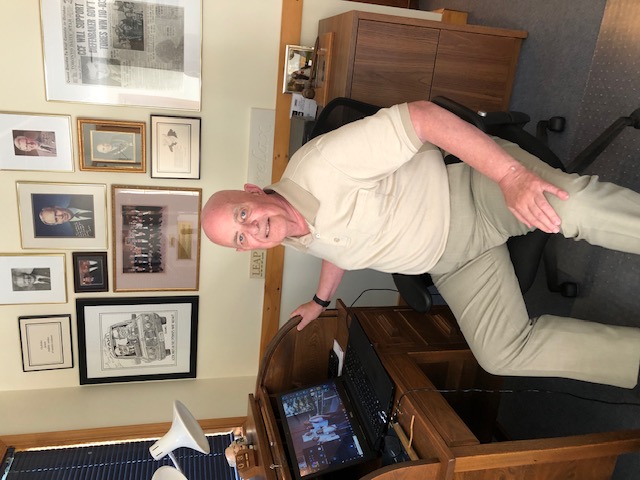
Hugh Mackenzie has held elected office as a trustee on the Muskoka Board of Education, a Huntsville councillor, a District councillor, and mayor of Huntsville. He has also served as chairman of the District of Muskoka and as chief of staff to former premier of Ontario, Frank Miller.
Hugh has also served on a number of provincial, federal and local boards, including chair of the Ontario Health Disciplines Board, vice-chair of the Ontario Family Health Network, vice-chair of the Ontario Election Finance Commission, and board member of Roy Thomson Hall, the National Theatre School of Canada, and the Anglican Church of Canada. Locally, he has served as president of the Huntsville Rotary Club, chair of Huntsville District Memorial Hospital, chair of the Huntsville Hospital Foundation, president of Huntsville Festival of the Arts, and board member of Community Living Huntsville.
In business, Hugh Mackenzie has a background in radio and newspaper publishing. He was also a founding partner and CEO of Enterprise Canada, a national public affairs and strategic communications firm established in 1986.
Currently, Hugh is president of C3 Digital Media Inc., the parent company of Doppler Online, and he enjoys writing commentary for Huntsville Doppler.
Don’t miss out on Doppler!Sign up here to receive our email digest with links to our most recent stories.
Local news in your inbox six times per week!
Click here to support local news

Canada needs P.P. so that Mark Carney has some kind of guidance as to what Canadians want and need. How many things has Carney implemented that P.P. would also have implemented? P.P. didn’t win his own riding because it is probably heavily populated by federal civil servants.. who were afraid that P.P. would slash the civil service.
I feel that you, as a die-hard liberal, have already started to campain for the liberals by demonizing the conseveritive leader even further. Your bias is obvious
Peppered Polvierre has been described as a ‘bark dog’ and not a ‘show dog.’