
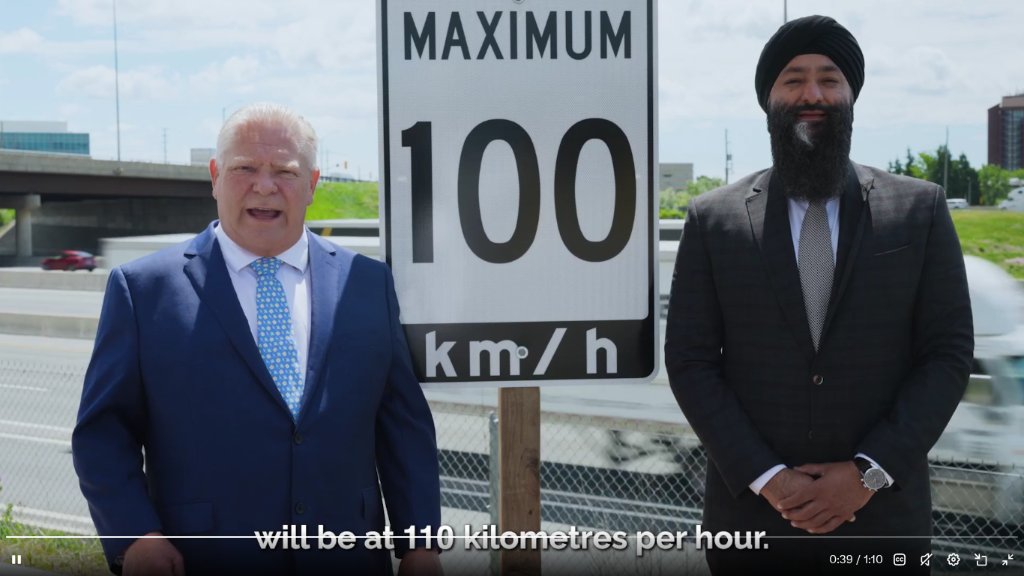
Starting June 26, 2026, the Ontario government will permanently increase the posted speed limit to 110 km/hour on the following sections of provincial highways:
- Highway 401 from Highway 15 to Highway 16
- Highway 416 from Cedar Grove Road to Highway 401
Following the implementation of 110 km/hour on the above listed sections, the Ontario government will permanently increase the posted speed limit to 110 km/hour on the remaining sections of provincial highways on the dates below:
- July 31, 2026
- Highway 402 from Highway 401 to White Oak Drive
- Highway 402 from Waterworks to 350m east of Colborne Drive
- August 21, 2026
- Highway 7 from Appleton Side Road/County Road 17 to Highway 417
- Highway 115 from Highway 35 to Parkway Interchange
- Highway 400 from Highway 401 to Lake Joseph Road
- Highway 416 from 1.5 km south of Highway 416/417 to Fallowfield Road/County Road 12
- Highway 417 from Leitrim Road to Ottawa Regional Road 174
- Highway 417 from Highway 416/417 Interchange to Highway 7
- August 31, 2026
- Highway 401 from Merlin Road to Highway 427
- Highway 401 from Highway 404 to Highway 35/115
- Highway 401 from Cobourg to Colborne
- Highway 401 from Sidney Street to CNR Overhead Bridge in Belleville
- Highway 401 from County Road 38 to Highway 15
- Highway 403 from Highway 401 to Middletown Line
- September 30, 2026
- Highway 403 from Queen Elizabeth Way (QEW) to Highway 401
- Highway 404 from Highway 401 to Mulock Drive
- Highway 406 from Westchester Avenue to Highway 58
- Highway 407 from Brock Road to Highway 35/115
- Highway 412 from Highway 401 to Highway 407
- Highway 418 from Highway 401 to Highway 407
- QEW from Freeman Interchange to Highway 403
- QEW from Concession Road to McLeod Road
- QEW from Mountain Road to Jordan Road
From the Government of Ontario
Don’t miss out on Doppler!Sign up here to receive our email digest with links to our most recent stories.
Local news in your inbox six times per week!
Click here to support local news

Now people will drive 120 km per hour because people were already driving 110 plus when the limit was 100.
Under the leadership of Premier Ford, our government is helping to increase travel costs, emissions and the risk of getting killed on our highways.
Driving at 110 km/h instead of 100 km/h directly increases fuel consumption and emissions by 10% per distance travelled and the risk of fatal collisions by 20%.
Fuel Consumption and Efficiency:
10% increase in fuel use: Reducing your speed from 110 km/h to 100 km/h decreases fuel consumption by roughly 10%. Conversely, pushing up to 110 km/h burns more fuel over the same distance.
Aerodynamic drag: Exponentially higher air resistance at 110 km/h forces the engine to work harder.
Financial and environmental impact: Higher consumption raises fuel costs for drivers and increases tailpipe carbon emissions.
The 20% Metric: A study in the journal Sustainability found that for every 10 km/h increase in speed limits on highways, fatal collisions increase by more than 20%. [1]
Crash Energy: Modest increases in speed produce disproportionately large spikes in kinetic energy, which causes more severe blunt-force trauma to vehicle occupants.